When working in a group, people need to be allocated specific roles because it means each area of production is given equal focus and the attention it needs to be successful. This therefore helps the final production be successful altogether.
jobs shared -not too much to focus on
Showing posts with label Planning the Thriller Production. Show all posts
Showing posts with label Planning the Thriller Production. Show all posts
Monday, 15 December 2014

Thursday, 4 December 2014
Opening Scene Narration - Miss Miller
Our sequence begins with a establishing long shot of an abandoned house so it is introduced as the home of the antagonist. The house we are going to film is located beside a forest in Buckhurst Hill. In the long shot we will zoom out from the house and pan across to show the forest. The second shot shows the entrance to an abandoned house, also in Buckhurst hill. We filmed a small gate and the trees just outside the house before creating a point of view shot as I walked through the entrance holding the camera. These two shots have natural low-key lighting so the sequence appears dramatic and eerie yet does not look too unnatural or artificial. A straight cut will link these two frames together subtly so it looks as though the two shots are both a part of the same house. Sound will be simple during these shots as it is at the start of the sequence and therefore building up to any dramatic events that will later occur. There will be an eerie whistling sound like the wind featured in both shots as well as possibly using quiet music that slowly builds up.
After that there are several panning shots of the interior of the house, showing the setting and several iconography items. Such as old photographs from the antagonist's childhood and broken items. These frames will be filmed in another house that belongs to our friend because they have wallpaper that has an eerie effect and we believed it would work well in our sequence. The lighting will be low-key again as these shots will be slightly more dramatic and harsh lighting will emphasize and focus on the iconography. When the childhood photographs are shown, we plan to edit in non-diegetic sounds of a child shouting for his mother and maybe chilling childlike music. The sequence will suddenly focus on certain iconography so jump cuts will be used over these frames.
A long shot inside the house then shows the back of the antagonist as he is looking at pictures on the wall. There are five polaroid photographs on the wall, each of a different victim of the killers.The camera will zoom in and focus on the images. All except one image will be crossed out in red marker and the antagonist will circle it. The four that are crossed out in red marker represent those he has already killed while the last image is of our sequences victim and she has not yet been killed by the antagonist which is why she is not crossed out. Throughout these frames, mumbles and cries of female voices will be played on loop to represent the antagonists previous victims and how killing them has affected him, making him more mentally unstable. When the antagonist circles the one image that is not crossed out this is where we will edit in the on-screen sound of a screech or scratch of the pen similar to hearing nails on a chalkboard. The lighting will be dark and low-key as the theme of these frames are very mysterious.
Further zooming in will focus on the circled image. It will be played to a non-diegetic sound like a 'whoosh' to highlight the movement and focus on the girl in the photograph. Using a jump cut, the shot of the polaroid will switch to a shot of the actual girl as she lays unconscious in another room of the house with masking tape over her mouth and around her wrists. She will move around and struggle until she is free from the tape. We will edit in the non-diegetic sound of creaking floorboards as the victim walks slowly through the house. She will escape and the slamming of a door will alert the antagonist. After this we will film both the victim and killer running though the forest in a chase scene. The lighting will be dark and low-key and several sound effects will be used. We will use sound tracks and sound effects such as footsteps and heartbeats.
After that there are several panning shots of the interior of the house, showing the setting and several iconography items. Such as old photographs from the antagonist's childhood and broken items. These frames will be filmed in another house that belongs to our friend because they have wallpaper that has an eerie effect and we believed it would work well in our sequence. The lighting will be low-key again as these shots will be slightly more dramatic and harsh lighting will emphasize and focus on the iconography. When the childhood photographs are shown, we plan to edit in non-diegetic sounds of a child shouting for his mother and maybe chilling childlike music. The sequence will suddenly focus on certain iconography so jump cuts will be used over these frames.
A long shot inside the house then shows the back of the antagonist as he is looking at pictures on the wall. There are five polaroid photographs on the wall, each of a different victim of the killers.The camera will zoom in and focus on the images. All except one image will be crossed out in red marker and the antagonist will circle it. The four that are crossed out in red marker represent those he has already killed while the last image is of our sequences victim and she has not yet been killed by the antagonist which is why she is not crossed out. Throughout these frames, mumbles and cries of female voices will be played on loop to represent the antagonists previous victims and how killing them has affected him, making him more mentally unstable. When the antagonist circles the one image that is not crossed out this is where we will edit in the on-screen sound of a screech or scratch of the pen similar to hearing nails on a chalkboard. The lighting will be dark and low-key as the theme of these frames are very mysterious.
Further zooming in will focus on the circled image. It will be played to a non-diegetic sound like a 'whoosh' to highlight the movement and focus on the girl in the photograph. Using a jump cut, the shot of the polaroid will switch to a shot of the actual girl as she lays unconscious in another room of the house with masking tape over her mouth and around her wrists. She will move around and struggle until she is free from the tape. We will edit in the non-diegetic sound of creaking floorboards as the victim walks slowly through the house. She will escape and the slamming of a door will alert the antagonist. After this we will film both the victim and killer running though the forest in a chase scene. The lighting will be dark and low-key and several sound effects will be used. We will use sound tracks and sound effects such as footsteps and heartbeats.
Monday, 1 December 2014
Risk Assessment - Miss Georgiou
It is important to consider the risks and hazards you may come across when filming a sequence because if you are faced with one on the day, you will know how to deal with it so it does not disrupt your filming. For example if it begins to rain on the day and we had not thought about it the camera would have got wet and stopped us from filming. Because we have thought about this potential hazard, we have decided to bring an umbrella with us to hold above the camera if it does begin to rain. Considering the risks and hazards will also allow us to prevent several hazards from occurring in the first place such as the possibility of tripping over the camera leads. By thinking about this and how we could prevent it we have decided to brink so masking tape when filming and stick the wires down to secure them and make it less likely for someone to trip over them.

Risk assessments will assist my group when filming because it makes each group member aware of what may go wrong or interrupt our filming. It will help us to take responsibility for anything that does go wrong and let us know what we can do to prevent this happening. To prevent hazards we have thought about, my group is going to bring an umbrella to hold above the camera in case in rains because that would damage the camera. We will also bring extra torches, be cautious of our surroundings and check the path before filming so that our actors do not hurt themselves by tripping or treading on something etc, in the chase scene, especially as our victim will not be wearing shoes. In case our actors, particularly our victim, gets cold or wet when filming the scenes we will bring coats to put on in-between filming. There is also the possiblity that members of the public could be in the background of our camera shots. To prevent this happening we will make any passers-by aware that we are filming.

Risk assessments will assist my group when filming because it makes each group member aware of what may go wrong or interrupt our filming. It will help us to take responsibility for anything that does go wrong and let us know what we can do to prevent this happening. To prevent hazards we have thought about, my group is going to bring an umbrella to hold above the camera in case in rains because that would damage the camera. We will also bring extra torches, be cautious of our surroundings and check the path before filming so that our actors do not hurt themselves by tripping or treading on something etc, in the chase scene, especially as our victim will not be wearing shoes. In case our actors, particularly our victim, gets cold or wet when filming the scenes we will bring coats to put on in-between filming. There is also the possiblity that members of the public could be in the background of our camera shots. To prevent this happening we will make any passers-by aware that we are filming.
Friday, 28 November 2014
Filming Schedule - Miss Georgiou
A filming schedule allows the group to plan and discuss when various parts of a sequence should be filmed. This is helpful because it means that the group are organised in understanding when and where they will be filming, making sure there is a set time for each part of the sequence to be created. So when my group arrives at the location we wish to film at, we will know exactly what content we will be aiming to create that day. A filming schedule is also helpful in that it reminds you of the iconography and costumes you need to bring etc.

This filming schedule helped my group to plan my sequence because it helped us to order the shots in our sequence into different sections. We grouped together the forest scene shots and the shots inside the abandoned house and decided to film them on two separate days and then at the end film what is left to film or re-film or another day. This means that the lighting and weather should be similar in the scenes that are in the same place. It also makes filming easier for us because we do no thane to go back and forth from locations and can get all of the filming in the forest scene done in one day and all of the abandoned house scene footage filmed in another.
Thursday, 27 November 2014
Group Storyboards - Miss Miller
The purpose of a group storyboard is to collect all of our separate ideas and put them together. It allows you to plan and prepare the sequence you will later create by placing all of your ideas in chronological order. As a group we all looked at each of our individual storyboards and decided on the best features of each before incorporating them into one group storyboard.

 We have created a group storyboard because it would allow us to plan our sequence effectively and give us a rough guideline to follow when filming. We have included specific elements from each others individual storyboards such as the panning of the houses layout that was on jessica's individual storyboard. We used ideas and shots for the chase scene from kerry's storyboard and shots of the killer marking off his photographs of victims from mine.

 Each group member had similar ideas of what we wanted from our narrative so it was easier to incorprate all of our ideas into one storyboard. We agreed that we wanted to show a shot of an old abandoned house for our first shot and I then decided that we should then featurea few shots of the houses interior to give some background information on the antagonist. The three of us then decided on the iconography we could use to create different effects, for example, an old family picture to highlight the hidden vulnerability of the killer.

 I think our storyboard is very clear and simple which makes it successful because it will be easy to follow and use as a guideline when filming. We managed to incorporate each others ideas by discussing our different ideas and opinions before looking and eachothers individual storybpoards and decidign how we could make them into one. We did make some compromises in terms of shots we could not use because it would have been impossible to use all of our ideas and shots from our individual storyboard so we had to leave some out. If I was to change something about our storyboard it would be the shots that show the layout of inside the house at sepcific detail as we have not seen inside the house we will film yet and so do not know what it will look like.


Monday, 24 November 2014
Individual Storyboards - Miss Miller
The purpose of a storyboard is ton produce a basic guideline and plan to follow when creating a sequence.
Before creating our group storyboard, each group member created an individual one because we wanted to be able to plan out all of our indicidual ideas and suggestions before incorporating them all into one final plan for our sequence. I hope my individual storyboard will help when planning our group one as I have several different ideas to incorporate different camera angles and editing techniques.
Pictures
I want the audiecne to be shocked, surprised an suspenseful when reacting to my sequence because that would make my sequence conventional to the thriller genre and keep the audience engaged, wanting them to keep watching after the opening sequence has finished.
I will incorporate my other group members ideas along with mine into our final group story board by looking at each others work as discussing ideas from each of our storyboards that we could use.
A Specific idea I hope they will take from my storyboard are the zooming out from frame four into frame five.
Before creating our group storyboard, each group member created an individual one because we wanted to be able to plan out all of our indicidual ideas and suggestions before incorporating them all into one final plan for our sequence. I hope my individual storyboard will help when planning our group one as I have several different ideas to incorporate different camera angles and editing techniques.
Pictures
I want the audiecne to be shocked, surprised an suspenseful when reacting to my sequence because that would make my sequence conventional to the thriller genre and keep the audience engaged, wanting them to keep watching after the opening sequence has finished.
I will incorporate my other group members ideas along with mine into our final group story board by looking at each others work as discussing ideas from each of our storyboards that we could use.
A Specific idea I hope they will take from my storyboard are the zooming out from frame four into frame five.
Friday, 21 November 2014
Planning Opening Credits - Miss Georgiou
Opening credits are used within films to give the audience an idea of the narrative by introducing the style of the film through fonts and background music etc. Colours can also reveal aspects of the narrative by portraying certain moods, themes and emotions that you may expect to find in the film. Additionally, opening credits introduce the names of the actors and directors of the film etc. The order of appearance of the names dictates the most popular or recognisable people to the audience. The filmmakers make sure the most well-known directors or actors are shown near the start of the opening credits to catch the audiences attention.
Se7en (1995)
As a class we watched the opening credits to Se7en and took notes on the colours, fonts and sounds used as well as the use of thriller conventions, style of credits and order of appearance.
The colours used in the sequence consisted mostly of black and white. The black connotes mystery, darkness, morbidness and danger while the white may represent innocence, vulnerability and hope. The two colours together may be representative of the killer and victim as the connotations of black relate to the antagonist ( dark and dangerous) and the connotations of white relate to the protagonist/victim (innocent and vulnerable).
There was also flashes and flickers of red in the credits. This colour could also represent danger and harm as it resembles blood. This suggests to the audience that some people may be harmed or killed in the film and therefore there must be victims and in turn a killer. The flickering and blurred effects was creating using the dissolve editing technique which gave an unbalanced effect and implied instability. Amongst all of the colours there was a slight filter effect that made the sequence appear sepia. This creates a dark and eerie atmosphere as the sequence is not entirely clear.
The words were placed over the images as they were the main focus of the opening credits and the .....
The font used in the sequence was messy and scrawly, similar to a child's handwriting. This gives the impression that the person in the opening credits is mentally unstable and psychotic which is conventional to a thriller because antagonists tent to be psychopathic and unpredictable as it creates a disturbing mood and makes the audience unaware of what they will do next and therefore keeps them engaged, uncertain and suspenseful. The characters psychotic nature is supported by the act of him cutting up items, writing messily, photocopying certain pictures and highlighting particular words. This suggests that he may be a serial killer and implies he is obsessive as he is planning out his acts of torture or murder. Obsession is a typical theme in the thriller genre because it makes the antagonist appear disturbed and creepy as well as unstoppable.
There were several conventions of a thriller evident in these opening credits. For example, suspense and enigma was provoked in the audience because there was no characters shown, only the hands of the male antagonist. This makes the audience question who he is, what he is doing and whether he is planning to hurt someone. The man uses sharp objects in some parts of the sequence which depicts danger and further highlights that he is psychotic and capable of killing or harming others. The timing of shots is varied in this sequence; some shots are slowed down and some are sped up by the use of editing. This is conventional to a thriller because it adds emotional impact and creates suspense. The viewer knows that the film will be full of faced paced shocking moments as well as a storyline that gradual builds suspense.
The last thing we focused on when watching and analysing the opening credits was the order of appearance in the words that appear because we would like to follow and mirror this order in our own sequence.
Order of appearance in Se7en:
1. Company name - "New Line Cinema Presents"
2. Directors name - "A film by David Fincher"
3. Well known actors names - "Brad Pitt...Morgan Freeman"
4. Title - "SE7EN"
5. More actor names - "Gwenyth Paltrow..."
6. Casting names - "Casting by Billy Hopkins..."
7. Music and Sounds - "Music by Howard Shore"
8. Costumes - "Costumes designed by Michael Kaplan"
9. Editors - "Edited by Richard Francis-Bruce"
10. Director of camera crew - "Director of Photography Darius Khondji"
11. Producers "Co-producers...Executive producers...
12. Writers of script "Written by Andrew Kevin Walker"
Watching the opening credits of Se7en allowed me to develop my ideas for my groups opening credits as well as seeing how I could incorporate our credits into our opening sequence. I understand the different aspects I have to consider when creating and incorporating my credits such as colour, sound, editing styles, fonts and order of appearance. I want my credits to be....simple,bold,creepy,childlike.black white red..
Our group then individually created our own draft opening credits to get an idea of what we would want our final group credits to look like. Because I wanted my credits to be simple I did not include any complicated effects and included mostly core colours of black and white to show the contrast between killer and victim and good and evil etc. A few seconds into the credits, when I start to introduce the actors names, the colour red is introduced. This connotes blood and danger which suggests the the audience that the film may be based upon a killer. The three bold colours are simple to look at and process as well as creating suspense and enigma because the audience do not get many ideas about the narrative. However, I do not like the font of the white writing because I think it lacks connotations. To improve this I would make the font resemble a childs handwriting, for example, because then it would create a psychotic theme. I would also make the white writing bigger as it is the title of the film but does not stand out from the other credits. It is not very excited or dramatic because it is too plain and simple and therefore it is not conventional to the thriller genre.

 |
| Screenshots of my opening credits After creating our opening credits, my group all looked at eachothers and discussed and analysed the advantages and disadvantages of them. I like Kerry's opening sequence because it also simple in the use of colours and effects which I find effective in opening credits in the thriller genre. The black and white colours also connote contrast within the film and the glow behind the letters suggest there is something that the audience does not know and will find out near the end of the film. This creates enigma and suspenseThe glow is also significant because it is upside down and backwards which gives the credits an unnatural atmosphere. This relates to the unnatural acts carried out by the antagonist in the thriller sequence. Overall, the credits are basic and simple because the words and colours are bold making it easy to read and understand. However, I think Kerry's opening sequence wold be better if there were connotations of red to suggest harm and danger and also if the credits were less clean cut and neat they would be more conventional to a thriller because the large, clean-cut boldness can resemble credits from an action film etc. |
 |
| Screenshot of Kerry's opening sequence |
I believe that Jessica's opening credits are the most effective as they are the most conventional to the thriller genre. Liker mine and Kerry's credits, Jessica's are clear and bold so are easy to read and process but unlike mine and Kerry's, the font is not too simple with slightly positive connotations. Instead hers appears less positive because the writing is slightly more scrawly which has connotations of instability and suggestions of a psychopath. The writing appears gradually in an irregular pattern. This represents the unravelling of events that would occur in the film. The colours are also black and white so they have the same connotations as mine and Kerry's but the credits would be more effective if there was use of red to add more connotations like in my credits. If I would change anything about Jessica's credits it would be the positioning of the words. I would place the words so that they are not in the centre of the screen. This will suggest instability and imbalance.
 |
| Screenshot of Jessica's opening sequence |
Wednesday, 12 November 2014
Planning Characters - Miss Miller
The purpose of characters and the planning of them in a film is important because it helps the audience to relate to them. This keeps them engaged as they are more interested in the narrative after relationships with the characters have been built.
Our opening sequence will feature only two characters who each play an active role in the sequence. The first being the victim that will be played by Kerry Boyne because she fits the description of this character and as she is a member of our group, she will understand the narrative more clearly. She will be presented as a normal teenage girl with long dark hair which fits in with the description of all of the sequences antagonists victims as his mum had dark brown hair and he has a resentful past with her. Our victim has been stalked and then captured by the serial killer. She will be wearing a long white dress and white shoes to portray her innocence. This character will be stereotypical of the genre because victims tend to be female as they are presented as more innocent and vulnerable.
She will scream several times in the sequence which is also stereotypical and conventional because screaming ia a sterotypical female response to fear and it will portray how scared our victim is feeling.
Another reason this character representation is stereotypical is because she is a young girl who has found herself in danger which is something she is not used to and therefore is more fearful and unknowing of what will happen next. This regularly happens in thriller films as it leaves the audience feeling unnowing anfd fearful also because they have built a relationship with the antagonist. Because they do not know what to expect, suspense is increased which puts them more on edge.
Certain features of this character will help the audience build a relationship with her. Such as the fact that she is just an ordinary person; a female student. This allows the audience to relate to this character as they feel that they are similar and so think that what is happening to the character could have happened to them. The audience imagines themselves in the victims position and at times watches the film from her perspective, causing them to feel empathetic towards this character.
The only other character in the sequence is the antagonist who is a serial killer. This character will be played by Eddie Woodley because we believe he fits the characteristics of our antagonists appearance; although he is younger than the antagonists estimated age, we believe he will look older because he is quite tall and has a big build which is conventional of a representation of a killer. He will be presented as a psychopath who has had an abusive childhood, this leads to him carrying out these murders.He will be wearing an all black outfit of a tracksuit with gloves, red dirty trainers and a white mask. The black and white is representitive of good and evil, him wearing mostly black represents that he is more bad than good. However the white colour of his mask could portray the innocence and vulnerability he felt in his traumatic childhood. The red of his shoes is a connotation for blood. This emphasises on the gory acts and murders he takes out on his innocent victims. This is stereotypical to the thriller genre because he will be carrying a knife which suggests murder and danger and reveals that he is about to hurt someone as well as focusing on him as a potential killer. This creates suspense and keeps the audience engaged as it depicts something bad is going to occur.
He will be wearing a mask as it is typical for murders to hide their identity as it builds suspense because the audience does not know what to expect and it is conventional for an antagonist to be a male as they are portrayed as more dominant. Obsession is a regular theme in a thriller and our antagonist will be obsessive as he stalks his victims before capturing and killing them.
The audience will be able to realte to this character because they may beable to empathise with him when they discover he had experienced a traumatic childhood.
I believe that our character representations are conventional because we watched examples of other successful thriller films and carried out research to find out that having a female victim and male antagonist was conventional and most successful. The colours worn by our characters and iconography such as a knife was clear to be conventional also in our research. I hope the characters emphasise on there representations when filming the sequence. For example, the victim must come across as vulnerable while the antagonist must come across as dominant.This planing has been useful in preparation to filming because it has allowed me and the rest of my group to discuss different representations we can include to make our sequence as conventional as possible.
Our opening sequence will feature only two characters who each play an active role in the sequence. The first being the victim that will be played by Kerry Boyne because she fits the description of this character and as she is a member of our group, she will understand the narrative more clearly. She will be presented as a normal teenage girl with long dark hair which fits in with the description of all of the sequences antagonists victims as his mum had dark brown hair and he has a resentful past with her. Our victim has been stalked and then captured by the serial killer. She will be wearing a long white dress and white shoes to portray her innocence. This character will be stereotypical of the genre because victims tend to be female as they are presented as more innocent and vulnerable.
She will scream several times in the sequence which is also stereotypical and conventional because screaming ia a sterotypical female response to fear and it will portray how scared our victim is feeling.
Another reason this character representation is stereotypical is because she is a young girl who has found herself in danger which is something she is not used to and therefore is more fearful and unknowing of what will happen next. This regularly happens in thriller films as it leaves the audience feeling unnowing anfd fearful also because they have built a relationship with the antagonist. Because they do not know what to expect, suspense is increased which puts them more on edge.
Certain features of this character will help the audience build a relationship with her. Such as the fact that she is just an ordinary person; a female student. This allows the audience to relate to this character as they feel that they are similar and so think that what is happening to the character could have happened to them. The audience imagines themselves in the victims position and at times watches the film from her perspective, causing them to feel empathetic towards this character.
The only other character in the sequence is the antagonist who is a serial killer. This character will be played by Eddie Woodley because we believe he fits the characteristics of our antagonists appearance; although he is younger than the antagonists estimated age, we believe he will look older because he is quite tall and has a big build which is conventional of a representation of a killer. He will be presented as a psychopath who has had an abusive childhood, this leads to him carrying out these murders.He will be wearing an all black outfit of a tracksuit with gloves, red dirty trainers and a white mask. The black and white is representitive of good and evil, him wearing mostly black represents that he is more bad than good. However the white colour of his mask could portray the innocence and vulnerability he felt in his traumatic childhood. The red of his shoes is a connotation for blood. This emphasises on the gory acts and murders he takes out on his innocent victims. This is stereotypical to the thriller genre because he will be carrying a knife which suggests murder and danger and reveals that he is about to hurt someone as well as focusing on him as a potential killer. This creates suspense and keeps the audience engaged as it depicts something bad is going to occur.
He will be wearing a mask as it is typical for murders to hide their identity as it builds suspense because the audience does not know what to expect and it is conventional for an antagonist to be a male as they are portrayed as more dominant. Obsession is a regular theme in a thriller and our antagonist will be obsessive as he stalks his victims before capturing and killing them.
The audience will be able to realte to this character because they may beable to empathise with him when they discover he had experienced a traumatic childhood.
I believe that our character representations are conventional because we watched examples of other successful thriller films and carried out research to find out that having a female victim and male antagonist was conventional and most successful. The colours worn by our characters and iconography such as a knife was clear to be conventional also in our research. I hope the characters emphasise on there representations when filming the sequence. For example, the victim must come across as vulnerable while the antagonist must come across as dominant.This planing has been useful in preparation to filming because it has allowed me and the rest of my group to discuss different representations we can include to make our sequence as conventional as possible.
Monday, 10 November 2014
Planning Editing Styles - Miss Georgiou
Editing styles are important to include within a thriller film because they help to provoke shock, suspense and surprise in the viewer which are all conventional to the thriller genre. They also engage the audience by helping them to build relationships with the characters and keeping them uncertain of what will happen next. This also builds tension so the audience will want to keep watching.
 As a group we discussed several different editing styles we could use in our opening sequence. The first being timing of shots. We will use this editing style when the victim is running through the forest, trying to escape. The sequence will be slowed down so every movement is emphasized and focused on, giving this part of the sequence a slow-motion effect. This will suggest that it is taking her a long time to run away and her escape is never ending as it will never come. She will inevitably be captured by the antagonist because there is no way out. In another part of the chase sequence we will speed up the timing of shots to create a very different effect. Using a point of view shot of the victim running into the forest, we will speed up the shot so it appears as though she is running away desperately and frantically. This will implie chaos and panic which the audience may also experoience feelings of as they watche the sequence and relate to the victim.
We have also decided to use filters in our sequence to create several different desired effects. Using the aged film filter can make a shot appear darker resembling the effect of low-key lighting, this makes the shot and lighting conventional to a thriller. The aged film filter also adds a flickering effect which can create a creepy, disturbed effect in representation of the antagonist. The dark lighting is a connotation of the antagonist and how he is dark and evil as well as being hidden for most of the time. Thois creates suspense as the audience do not see the antagonist as much in the sequence and threfore wonder where he is and if he will jump out suddenly. It also makes them wonder and fear what he will do to the victim when he captures her as they know from the low-key lightng and filters that he is dark, creepy and disturbed.
Another filter we are thinking about including is a red coloured one. This could be used when the victim is running from the killer im the forest because it will deepict danger and caution which will crrate suspense as the audience believe the antagonist is close to catching her. The red also has connotations of blood and murder which foreshadows how it could end for the victim. This is conventional because blood and fear is usually presented or portrayed in the form of the colour red. The audience will be able to see these filters, unlike the victims. Therefore, they will understand what is going to happen next to the victim while the victim does not. This causes them to feel empathetic towards the character and in turn build a relationship with her.
The third editing technique my group discussed using was a reaction shot. We will use this when the antagonist realises the victim has escaped the abandoned house. The first shot is off a door slamming after the victim has untied herself and escaped through it and then the reaction shot it of the antagonist turning his head around in a sudden and serious manner before he continues to chase and capture the victim again. The antagonist will be facing a wall in a seperate room where there are pictures pinned up and circled. After the door slams, he will turn his head to face the camera that will be behnd him. This will be done in one sharp movement so the shot is very short because it will emphasise the panic of the killer as well as portraying how he is not waiting around for long and straight away hurry's to capture her again. The sharp movement also proves that the antagonist is not in control for once as he is usually slow and calm to show his confidence and that he knows he will win.
The audience will feel a sense of urgency, hope and encouragement for the victim to keep running and to escape so she does not get harmed and the antagonist will be caught and stopped. However, they know that this is unlikely to happen as it is conventional to the thriller genre for a victim to always be caught in the end after a near escape. This provokes suspense and tension in the audience.
Finally, we decided to include the Kulveshov effect. This is when two shots are shown together to imply something that the audience did not see first hand. In our sequence, we will show a shot of the antagonist circling an image of the victim in red pen before showing a shot of the victim tied up on the ground in a different room. In the first shot there will be several images of previous victims on the wall that have been crossed out in the same red pen. This will suggest our antagonist is a serial killer and our female character is his next victim.
 As a group we discussed several different editing styles we could use in our opening sequence. The first being timing of shots. We will use this editing style when the victim is running through the forest, trying to escape. The sequence will be slowed down so every movement is emphasized and focused on, giving this part of the sequence a slow-motion effect. This will suggest that it is taking her a long time to run away and her escape is never ending as it will never come. She will inevitably be captured by the antagonist because there is no way out. In another part of the chase sequence we will speed up the timing of shots to create a very different effect. Using a point of view shot of the victim running into the forest, we will speed up the shot so it appears as though she is running away desperately and frantically. This will implie chaos and panic which the audience may also experoience feelings of as they watche the sequence and relate to the victim.
We have also decided to use filters in our sequence to create several different desired effects. Using the aged film filter can make a shot appear darker resembling the effect of low-key lighting, this makes the shot and lighting conventional to a thriller. The aged film filter also adds a flickering effect which can create a creepy, disturbed effect in representation of the antagonist. The dark lighting is a connotation of the antagonist and how he is dark and evil as well as being hidden for most of the time. Thois creates suspense as the audience do not see the antagonist as much in the sequence and threfore wonder where he is and if he will jump out suddenly. It also makes them wonder and fear what he will do to the victim when he captures her as they know from the low-key lightng and filters that he is dark, creepy and disturbed.
Another filter we are thinking about including is a red coloured one. This could be used when the victim is running from the killer im the forest because it will deepict danger and caution which will crrate suspense as the audience believe the antagonist is close to catching her. The red also has connotations of blood and murder which foreshadows how it could end for the victim. This is conventional because blood and fear is usually presented or portrayed in the form of the colour red. The audience will be able to see these filters, unlike the victims. Therefore, they will understand what is going to happen next to the victim while the victim does not. This causes them to feel empathetic towards the character and in turn build a relationship with her.
The third editing technique my group discussed using was a reaction shot. We will use this when the antagonist realises the victim has escaped the abandoned house. The first shot is off a door slamming after the victim has untied herself and escaped through it and then the reaction shot it of the antagonist turning his head around in a sudden and serious manner before he continues to chase and capture the victim again. The antagonist will be facing a wall in a seperate room where there are pictures pinned up and circled. After the door slams, he will turn his head to face the camera that will be behnd him. This will be done in one sharp movement so the shot is very short because it will emphasise the panic of the killer as well as portraying how he is not waiting around for long and straight away hurry's to capture her again. The sharp movement also proves that the antagonist is not in control for once as he is usually slow and calm to show his confidence and that he knows he will win.
The audience will feel a sense of urgency, hope and encouragement for the victim to keep running and to escape so she does not get harmed and the antagonist will be caught and stopped. However, they know that this is unlikely to happen as it is conventional to the thriller genre for a victim to always be caught in the end after a near escape. This provokes suspense and tension in the audience.
Finally, we decided to include the Kulveshov effect. This is when two shots are shown together to imply something that the audience did not see first hand. In our sequence, we will show a shot of the antagonist circling an image of the victim in red pen before showing a shot of the victim tied up on the ground in a different room. In the first shot there will be several images of previous victims on the wall that have been crossed out in the same red pen. This will suggest our antagonist is a serial killer and our female character is his next victim.
Friday, 7 November 2014
Group Planning - Miss Georgiou
My group, Signal Cinema, consists of Kerry Boyne, Jessica Mccullaugh and myself. My group has regular group meetings to discuss and plan our opening sequence. These group meetings are essential to have as they allow us to transfer opinions and have a clear idea of what we have done, what we will do and what we need to do. Our first meeting took place on 13th October where we agreed and decided on a group narrative by discussing ideas and concepts that each group member had. We then reflected on these ideas and decided on a final narrative for our opening thriller sequence.
On the 24th October my group planned the opening sequence at more detail. We created two sheets to help us plan and decide what to do. The first sheet was split up into four sections so we could think about the four diffwerent aspects of our opening sequence. We brainstormed ideas for Mise-en-scene, cinematography, sound and editing. On the other sheet we discussed the inspirations we had gotten from other media sources, the target audience we would want our sequence to be, codes and conventions of the thriller genre we would like to include and the representation of our two characters.


On the 10th of November we watched a short video clip from The Woman in Black before discussing at further detail than our previous meeting what editing techniques we would like to include in our sequence. Watching the sequence from Thw Woman in Black allowed us to see what editing techniques were successful in a thriller film. We learned that the timing of shots is effective as it adds creates suspense if a shot is slowed down. This makes the audience nervous and anxious, keeping them engaged. Filters are also effective to use because they manipulate the mood and atnmosphere of a shot by altering the colours and lighting slightly. They can help to create a look that is unnatural and eerie which makes the audience expect that something eerie and unnatureal will occur soon.
Our next group discussion was focused on the use of sound in thrillers. Again, we split an A3 piece of paper into four sections and labeled them: diegetic, contrapuntal, non-diegetic and off-screen. Under each of these headings we brainstormed ideas of these sound types we could include in our sequence. We also discussed when we would include these sounds, how they would help the audience relate to the characters, what effect they have overall and how they are conventional to the thriller genre.
On the 12th November, we discussed the representation of characters in our opening sequence by divinding an A4 piece of paper into two halves. On one half we brainstormed and wrote down ideas about ouur antagonist and on the other we wrote about our victim. We wrote about the background story of the characters, their age, what they would be wearing, whop they would be played by and their gender. We decided that Kerry would play our victim before discussing who could play the antagonist.
Meetings and discussions are important to carry out because it makes planning the final production easier as each group member can clearly see what we have already done, what we need to do, what we need to improve and what else we should consider. I think my group worked well together because we all had several different ideas to share in each meeting.
Planning Mise-en-Scene - Miss Georgiou
Mise-en-Scene within films is important because it takes most aspects of the sequence into consideration and therefore covers most bases. This allowed my group to think about several conventions of a thriller when planning our sequence. Planning is required in order to produce excellent sequences because it provides a basic guideline for us to follow and set of ideas for us to refer back to.
Setting & Iconography
Our opening sequence will take part in an isolated setting: an abandoned house in the middle of a forest. This convention focuses on the female character as a potential victim because she is seemingly alone. This makes the audience and character wonder what will happen next and if she is really alone. An isolated setting is a typical convention of a thriller film because victims are usually isolated first before something bad occurs. This makes the audience feel alone and frightened like they expect the character to be feeling. They have put themselves into her point of view because they have built a relationship with her and worry about her safety.
Iconography in our sequence will include old family photographs, polaroids of previous victims, rope to tie up the victim, blood splats on surfaces, pictures of the victim taken without her realising and autumn leaves on the ground.
Iconography in our sequence will include old family photographs, polaroids of previous victims, rope to tie up the victim, blood splats on surfaces, pictures of the victim taken without her realising and autumn leaves on the ground.
Costume, Hair & Make-up
The victim will be wearing a white flowing dress and white socks that will portray her innocence. Both will be muddy and dirty to emphasise on the fact that her innocence and her vulnerability is being corrupted by the dangerous and frightening circumstances she has found herself in. Her make-up will be natural to prove that she is an ordinary person. This will allow the audience to build a relationship with her because they can relate as they feel she is similar to them and so imagine themselves in her situation. Her hair will be long and dark like the antagonists mothers to reveal ideas of our narrative to the audience.
The antagonist will wear a black tracksuit with the hood pulled over his head. He will wear latex gloves on his hands to depict that he is about to kill and he will wear dirty trainers. Contrasting to his mostly dark clothes he will wear a mask that is white. It is typical for a killer to hide their identity from the victims and the audience. This explains elements of the narrative as well as connoting enigma.
The antagonist will wear a black tracksuit with the hood pulled over his head. He will wear latex gloves on his hands to depict that he is about to kill and he will wear dirty trainers. Contrasting to his mostly dark clothes he will wear a mask that is white. It is typical for a killer to hide their identity from the victims and the audience. This explains elements of the narrative as well as connoting enigma.
Body Language & Facial Expressions
The protagonists shocked, panicked and fearful facial expressions will be emphasised using certain camera techniques such as close ups. She will appear cowering ans nervous in most scenes to highlight her vulnerability. Due to having no identity, the antagonist will appear emotionless and not remorseful.He will be presented as dominant, confident and bold because he will be walking slowly and steadily behind the victim in the chase scene when she is running frantically. This suggests that he is confident that he will capture her.
Lighting & Colour
Low-key lighting will be used regularly in our sequence as it creates dark shadows around the characters faces as well as connoting tension and enigma.
Positioning
The house will be positioned in the middle of the forest as it is an isolated abandoned setting. The antagonist will always be positioned standing above or taller than the victim, to represent how he is dominant while she is vulnerable.
Planning Sounds - Miss Miller
Sound within films is just as important as the image as it helps to manipulate the mood, perspective and emotions of the audience as well as adding rhythm. It helps to build shock, surprise, suspense and tension in several different ways. For example, in a thriller film, if a sound is fast paced and loud then this may represent danger that the victim may be in or silence could represent the end of a characters life. Sound links in with images used by representing or emphasising on what the audience can see.Additionally, sound helps the audience to understand the characters as they represent their thoughts and emotions and sometimes what is about to happen to them. This keeps the audience more engaged in the film. Sound in film is split up into several categories: diegetic sound is sound that is part of the narrative, for example dialogue or footsteps. Non-diegetic is the opposite and therfore it is sound that is not a part of the narrative and is edited in later, for example sound effects or music. When a sound is off-screen it means the audience cannot see where the source of the sound is while on-screen sound is when the audience can see the sound source. Planning sound is required in order to produce excellent sequences because it gives my group a chance to consider the different effects we can create for the audience using sound. It also helps us to create a guideline for our thriller sequence so we have a structure when creating it.

A Non-diegetic sound we have decided to use is the sound effect of a heartbeat. This will show the panic of the victim and will be played during the chase scene when the victim is running through the forest. I hope that this sound technique will portray the victims fear, stress and panic as the antagonist chases after her. I will ensure that the audience build a relationship with the victim throughout this sound as their heartbeat will be speeding up also and beating along with hers. This allows the audience to put themselves in the victims position and understand the emotions they are feeling. This causes them to feel sympathetic towards them. This is conventional to the thriller genre because it creates tension and suspense, making the audience wonder what all happen next.
We will also include several diegetic sounds such as screaming, heavy breathing and footsteps. All of these will also be included in the chase scene. This will emphasise the anxiety and fear of the victim, heightening the emotions so the viewer can see the sequence from her perspective. This will allow them to build a relationship with her because tension is being built and the viewer will feel uncertain and worried about the victim. They hope that she will escape and are scared that she will not. These sounds are typically used in the thriller genre as they provoke suspense and tension.
The contrapuntal sound my group has decided to use in our sequence is music that is positive or possibly 'happy' or 'cheerful'. This will be played when the victim is being dragged back to the house by the killer after the chase scene. This juxtaposes the two themes because the sound does not match the expectations. The happy music is not expected when a aggressive act is taking place. The music conveys the antagonists happiness as it is clear he is enjoying carrying out the gruesome activities on innocent victims and he is glad to have finally caught her after she attempted to escape. This emphasises on his sadistic nature. He has now overpowered the victim which is demonstrated by the happy music overpowering the tension building sounds of her escaping (footsteps and heartbeat etc). The audience now understands that there is no chance that the victim will survive and therefore feels pathos and sympathy. This is conventional to a thriller as it creates an unnatural atmosphere to highlight that the antagonists acts are also unnatural. This implies uncertainty and disturbance which in turn creates suspense.
The off screen sounds that will be used in our sequence are a creaking door and the same door shutting. The creaking door will take place when the girl is trying to escape the house and the slamming of the door will be when she escapes and the killer notices she has gone. The sound of the door creaking highlights the nervousness and anticipation of the victim as she is desperately trying to be silent so she can escape without being caught. This sound provokes panic as the audience and vicitm wonder if the killer heard it. The sound of the door shutting may shock the audience as it will be a sudden loud sound thast may be accompanied by a non-deigetic bang. The audience will also feel nervous and worried for the victim as they know thatthe antagonist did hear that sopund that time and therefore he will attempt to chase after her. The sound symbolises the start of a chain of events that all increase tension more and more until the end of the sequence.
Our sequence will be more effective in terms of creating certain emotions and reactions through the use of sound because the audience will feel more engaged as they understand the emotions and thoughts of the characters more. Also, they are kept guessing of what will happen next when tension and suspence is built through thte use of sound and they may be shocked or scared when a loud sound takes place. Sound is conventional in relation to the thriller genre because it helps to create shock, suspense and surprise. For example, suddenly cutting to silence after building tension will make the audience expect a 'jump scare.'
I found the planning useful in preparation for filming my opening thriller sequence because it gave the rest of my group and I an idea of what sounds we need to consider using to create certain effects in our sequence and make it successful. It also helped us to visualise the way our sequence will look and when we will add our desired sounds to the sequence. It hwlped us to understand how much sound we will have to edit in and how many will be created naturally as we film due to thinking about how many diegetic and non-diegetic sounds will be used.
Wednesday, 5 November 2014
Planning Cinematography - Miss Miller
It is important to use cinematography within a film sequence because it helps to portray different atmospheres and emotions and manipulates the mood of the audience.It also portrays the dominance and status of characters, giving the audience ideas about the narrative. Planning is required in order to produce excellent sequence because it allows yo u to think about the objects and characters or facial expressions that are focused on or emphasised in a shot that can give the audience information about the narrative or help them build a relationship with the characters. Thinking about different subjects to focus on gives you a basic guideline to follow as you create your sequence. It helps you think about all possible cinematography techniques to use and therefore allows you to use as many as possible.This is what my group have done; we discussed ideas for cinematography which allowed us to all visualise the sequence similarly.
As a group, we plan to use a variety of camera angles, shots and movements. I will aim to use a high angle shot by positioning the camera above the subject, making them appear smaller. The shot will take place in an isolated setting; the victim is tied up in a dim room in an abandoned house that is in the middle of a forest with seemingly no one else around. .I will use this shot when the victim is tied up in the abandoned house because I hope this will highlight the vulnerability and inferiority of the victim. This helps the audience to build a relationship with her as they imagine themselves in her position and how they would feel. Because of this they feel empathy for the character. This convention shows her as a possible victim because she is alone. This makes both the character and audience wonder what will happen next. This is conventional to a thriller film because it exposes the vulnerability of the character and focuses on her as a potential victim which engages the audience as they want to see what will happen next. An isolated setting is a typical convention of a thriller film because victims are usually isolated before something bad happens as this means there is no one around to help. This makes the audience feel alone and frightened like they expect the character to be feeling. They have put themselves in her point of view because they build a relationship with the character and feel worried about her. The audience also feel uncertain and expecting of something bad to happen.
 |
| High Angle Camera Shot |
I will also use a low angle shot which is the opposite to a high angle shot as the camera is positioned below the subject, making it appear bigger so the camera shot also has the opposite effect on the sequence to a high angle shot. This shot will be used when the antagonist is looking over the victim at the end of the chase scene. I hope this will portray dominance and confidence as it is suggested he has done this before so knows what he is doing and so the audience understands the victim will inevitably be captured by him. The viewer will build a relationship with the victim from this angle as they will share her emotions, such as fear and anxiety. This is conventional to the thriller genre as it creates suspense by focusing on him as a potential killer to keep the audience engaged. Another reason the audience is engaged is because they do not know what will happen next. It also makes the audience feel as though they are a part of the scene and therefore share emotions of the characters ad fell as if it is happening to them which allows them to build stronger relationships with both characters.
 |
| Low Angle Camera Shot |
My group initially planned to use the panning technique as a camera movement in our opening thriller sequence to reveal the interior of the house and show several different iconography items and aspects of the setting that suggest ideas about the narrative. However, panning is when the camera moves from steadily side to side to follow a moving object and we did not plan to have a moving object in this scene so we decided to use steadicam instead as the camera still remains perfectly level and steady as it moves around but it does not need to follow a specific object. Hopefully this will portray how rough the conditions are, asking the question why would the man live there. As well as giving the audience an idea of what the storyline will entail and some aspects of the antagonists background story. This will help the audience build a relationship with the victims because they feel sympathetic as they now see the conditions that they are being kept in. A relationship is also built with the antagonist because elements of his background story re revealed and so the audience may feel empathetic towards him. This is conventional to a thriller as it explains the story line to the audience and because no characters are shown in this shot, the audience feels as though they are there and looking around the house themselves. Enigma is connoted because the audience wonder why a man would live in these conditions and why his is killing people.
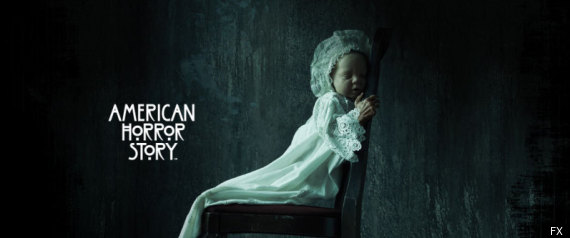 |
| These images are all taken from the opening sequence of American Horror Story |
 |
Another camera movement technique we have decided to use is Handheld which is used to create jerky and unsteady images. This technique will be used when the victim is running through the forest in the chase scene. This can also be seen as a point of view angle as we will create the shot so that the audience sees what the victim sees as she runs. I hope this will portray a sense of chaos and urgency which is conventional to a thriller film because it procokes panic and uncertainty in the viewer.This camera technique will also focus on the fear of the victim and her want to escape. We will accompany this technique with sound effects that will further increase the feelings of fear, panic, chaos and uncertainty. We will use sounds such as a beating heart, heavy footsteps and ragged breathing. This is typical of a thriller film because it creates suspense and tension as the audience wonders whether or not the victim will escape. They will also be hoping that she does escape which helps them to build a realtionship with her because the point of view angle allows them to put themselves in her point of view and therefore feel empathic towards her.
 |
| Handheld Camera Movement |
Next we decided that an extreme close-up will be effectve to use once the victim has fallen down in the forest and the antagonist drags her backwards. An extreme close up is when an image fills the screen so no background is seen. The camera will focus on her facial expressions before she is dragged backwards. This will empahsise on her fear which allows the audience to realte because both them and the character wonder if the anagonist will find her. This creates suspense and keeps the viewer engaged as they do no know what will happen next. The victim is exposed as vulnerable with makes the audience feel sympathetic.
As the victim is dragged backwards, shock will be provoked in the audience which is conventional to a thriller film as well as the fact that the audience will feel helpless as they now have an idea of what will happen next as it is conventional of a thriller film for the antagonist to take the victim by surprise before they are attacked or killed.
 |
| Extreme Close Up Camera Position |
The last cinematography technique we discussed was shallow focus. This is used to show a main subject in full focus whilst the rest of the shot is out of focus and blurry. We will this technique near the start of our sequence when the antagonists polaroid pictures are pinned on the wall and the camera sans over them. It will then focus in on the last image (of his next victim who is tied up in the house) and everything else will become unfocused. Hopefully, this will portay that ye victim is his next focus and that the others he killed are no longer important to him. They are just a blur in his mind and he is umpased by the amount of innconet people he has killed. This shows that the antagonist is not symapthatic or affected by his murders like most others would be and that he is psychologically damaged because of this. This part of the sequence will allow the audience to build a relationship with the antagonist as they can see what he would be seeing. It also allows them to see into his head and understand what he is thinking. From the pictues they can see he has killed previously and is therfore a serial killer, they understand killng does not effect him negetively like it would do to others and they understand that he is about to kill again as he focuses on the lasty picture of his next victim. The audience knows that once he has killed her, he will move on again and his focus will be on his knew victim. He will keep doing this until he stops which makes the audience ownder if he ever will be stopped, keepinmg them engaged and wanting them to watch the entire film. This is conventional to the thriller genre as it provies a clear narrative of what the antagonist is thinking and aiming to do. The audience know that the victim is going to die before she, herself knows.
 |
| Shallow Focus Camera Position |
I think my sequence will be more effective through the use of cinematography because it can create several effects on the audience by empahsising on a subject or manipulating how it is presented in a shot. Planning each cinematograhy technique out like this, allowed my group to have a clear image of what our final opening sequence will look like. It is conventional in relations to the thriller genre because one main aim of cinematography is to provoke shock, suspense and surprise in the audience as well as building tension and making them jump. It also places character representations, empasisesd different atmospheres and emotions and creates enigma around a scene to engage the audience. I found this planning helpful in preparation for filming because it allowed my group to put all of our ideas together and produce a structure for our thriller sequence.
Friday, 17 October 2014
Group Narrative and Narrative Theory - Miss Georgiou
My opening sequence group consists of myself, Kerry Boyne and Jessica Mccullagh.
My narrative idea - The idea I have for our narrative is to base the sequence on a chase scene in the forest. The start of the opening scene will be a zooming shot of the abandoned house in Buckhurst Hill. This will introduce the setting and highlight the fact that the house is abandoned and isolated, creating a feeling of vulnerability.
The inside of the house will then be introduced to the audience, panning around the interior and showing pictures on the wall that are marked as the psychopaths previous victims. The antagonists presence will be shown but his identity will be hidden to create a theme of enigma around the character. Instead of a clear view of the killers face, the camera will show shadows and silhouettes of him, shots that are too close up to see the man at detail and shots from the killers point of view. The audience will not know who the killer is, what they look like and therefore will question their reasons and purpose for carrying out the murderous acts.The antagonist may even be wearing a mask to hide his identity completely.
The protagonist will be locked in a room or tied up in the house. She will escape and begin to run away. The antagonist would be chasing the girl through the forest. He would be walking fairly steadily while the protagonist would be running quickly. Eerie music and various sound effects will be used to increase suspense.
I have highlighted the advantages of my narrative in green and the disadvantages in red. A disadvantage would be that you cannot see the antagonists face at clear detail. This means you will not be able to see that he is masked and it may confuse the viewer about the character and who they are. You also do not know much about the killer and his victim. I should explain his purpose for carrying out these acts and elaborate on why he has chosen that girl. He could have stalked her. If so, I will prove this by using images of her that look like they have been taken from a distance without her knowing. i would use this iconography and pin it on the walls.
Advantages include that the different camera angles portray different effects like dominance and vulnerability. The identity of the killer is hidden which is conventional to a thriller because the audience questions who they are and what they're purpose is, creating enigma and suspense. Another effect convention is that the walking speed of the victim and antagonist is different. He is walking slowly while she is running away quickly. This conveys that he is confident and knows he will eventually catch her. This tells the audience that he will inevitably catch up with her and increases suspense.
Kerry's narrative idea - The narrative idea that Kerry is interested in focuses on having an abandoned house or building belonging to a psychopath. The protagonist would be a woman who gets split up from her friends and becomes isolated from her friendship group and becomes his next victim, who he has been spying on for a while. In the house there will be pictures and blood splatters on the walls. The antagonist will be presented as somebody who is psychologically damaged and therefore creepy and unpredictable. A low angle shot can present the antagonist as the dominate character. Other iconography she suggested to use is a knife, broken glass, dusty old books and blood splatters on a work surface. This shows the antagonist has killed before and is conventional to a thriller film as it creates suspense. We could create low-key lighting by filming at a certain time of the day, considering how the surroundings effect the appearance of the sequence. Using different camera techniques and editing devices such as fading, zooming and point of view shots allow the sequence to appear realistic and create a sense of suspense and shock as these key thrillers make a thriller conventional. Sound she considered using included the blowing out of a candle, screaming, heavy footsteps and rain fall.
The female victim will be wearing a white dress.
Disadvantages of Kerry's narrative include certain aspects of the plot that could be changed to become more effective. Instead of the female victim being split up from her friendship group. She could already be in the house, tied up and trapped. This would mean the only two characters in the sequence are the protagonist and the antagonist, increasing the feeling of isolation and making the protagonist appear in more danger.
Her initial idea of a group of friends in the forest lacks detail as well because she has not explained why they are in the forest in the first place and this may confuse the viewer. It also makes the protagoist appear more safe because there is the chance that her friends could hear or see her and help her escape. This decreases the feeling of danger that creates suspense in the audience. Also it is too coincidental that the girl is his next victim that he has been spying on for a while and he suddenly comes across her in a forest.
Advantages of her narrative are that the location is an abandoned house which is a very isolated environment that creates tension because the audience knws there is nop one else around to help or hear the victim. The protagonist being a woman makes her appear more vulnerable because the anatgonist who is male is more dominate and strong. This increases suspense in the audience because furthermore they know that it would be very hard for her to escape. The white dress that the victim wears is a good representation of her character because it displays her innocence and would look effective as it would be slightly dirty showing how her vulnerability has been corrupted and as she runs from the man it would blow about in the wind which could be effective. Also the white would contrast well with the antagonist if he was wearing dark clothing.
In my History of Thrillers post, I discovered that an antagonist being creepy and unpredictable is effective to the audience because they do not know what they will do next and this creates suspense. Kerry's idea was to have the antagonist in our sequence be creepy and unpredictable so it would have the same effect.
Jessica's narrative idea - Jessica's idea is to have a couple who have gone camping in a deserted campsite for Halloween. The couple are then found by a mysterious masked killer who attempts to attack and then spends the night chasing them. The face of the antagonist would not be revealed until the end of the film so in the opening sequence his identity will remain hidden. He will be carrying a knife as it easily intimidates the victims and is a quick way to carry out an attack. There are two protagonist's in Jessica's idea; one is a male and one is female and they are both around the age of eighteen. They will be dressed in bright clothing to portray their innocence.The opening sequence begins with the couple sitting by their tent and the lighting is low key and pitch black. They are in a deserted campsite, around midnight.
Both mine and Jessica's narrative ideas feature a chase scene so that will probably be a main aspect of our opening sequence story line. Another convention we both decided on four our ideas was using a knife as an example of iconography. Jessica suggests that low-key lighting is used which will create a dramatic effect. However, she also suggests that at some point in the sequence the lighting should be pitch black. This will make it unclear for the audience to see what is happening in the sequence and so may confuse them about the narrative. A male protagonist was proven not to be as effective in our research because most people believed that a female victim appears more vulnerable and powerless so using a male as well would not be as threatening especially as their is an imbalance of more protagonists than antagonists.It will be difficult to locate our sequence in Jessica's desired setting because we will need to get permission to film at a campsite, especially at midnight. As well as the fact that there will be other family's around so they might portray a happy atmosphere and it would be hard to make the setting seem deserted. Like my narrative Jessica should elaborate on the killers background and why the victim is being chased.
As a group we have decided to use aspects of all of our narrative ideas to produce a final group narrative. Our story line is based on a psychotic serial killer who as a child was abused by his mother which has damaged him mentally. Because of this he captures and kills young innocent girls with dark hair that resembles his mother in a form of revenge.
The opening sequence begins with a high angle shot of an abandoned house showing the antagonists vulnerability as a child and also the vulnerability of his victims. Panning and Steadicam shots show the audience the interior of the house, focusing on iconography such as old photographs of his mother, blood splattered on work surfaces, religious objects and broken glass before the antagonist is introduced. He will be wearing dark scruffy clothes such as a black hooded jumper and dirty trainers. He will also be wearing a mask to conceal his identity.The mask will be plain white, which conveys he has no emotions and the white has connotations of his innocence as a child.
A mid shot will then show him looking at many polaroid photographs on the wall. These photographs are of previous or future victims. The previous victims photographs have a cross marked on them in red. We will then focus in on one last photograph of his next victim. The antagonist will circle this picture and then the camera will zoom into the photograph suggesting she is going to be killed next.
After this the camera will change, there will be a close up of our victims face.After this the camera will suddenly change to a close up of the actual victim. This will help to emphasize her emotion. First the victim has her eyeas closed as she in unconcious and then whilst the camera is slowly zooming out the victim will wake up and look around at her surroundings and then start to panic. Following this, the camera will zoom out more rapidly so that the audience can see the situation that the girl in is (she will be tied up old rope in an empty room of the abanmdoned house). She will be scared, crying and panicked. Following this, the camera will zoom out so that the audience can see the situation that the girl in is. She will be tied to a chair with rope. She will be wearing a white floaty dress to show her innocence. However it will be dirty due to the circumstances and surroundings. The dirty marks on the dress will show how the antagonist has corrupted the victims innocence and vulnerability. The room will be dark and we will use low key lighting. There will also be blood on the floor along with pieces of clothing from previous victims.
The victim will then struggle in the chair and eventually break free before running out of the house and through the forest. As she exits, the antagonists attention would be captured by a noise the victim makes as she escapes. A loud and sudden sound effect will accompany a fast zoom to provoke shock and suspense. A close-up of the victims face appears as she realises she has been too loud. The antagonist will sprint to the door and chase her out of the house. A frantic chase through the forest would then take place. The antagonist would walk steadily behind the victim as she runs quickly. The antagonist doesn’t run fast but instead has a more slow powerful walk with heart beat and footstep sound effects to increase tension. This will make the antagonist appear confident and as though he knows he will eventually capture her. This makes the audience believe there is no chance that she will escape.
Eerie music and various sound effects will be used to heighten the suspense. Another idea we have is to use happy hunting music as a contrapuntual sound.We have two possible endings for our sequence. The first idea ends the sequence as the victim finds herself at a dead end. The camera will cut to a low angle shot of the antagonist as he walks slowly towards the victim with his knife held above his head. The killer will keep walking and the sequence will fade to black. Then, as the title of the thriller film appears on the screen the audience will hear the scream of the victim, implying she has been killed by the antagonist.
Another way the sequence could end is by the victim tripping over something in the forest and not being able to physically move because of her pain so she would scream and struggle which gives the antagonist time to catch up with her. She tries to drag herself along the floor to get up but cannot. The camera will cut to a low angle shot of the antagonist as he walks slowly towards her. The scene goes completely silent and an extreme close up occurs of the victims face where she is breathing heavily. From this reaction shot the timing of the shots speeds up as the victim suddenly gets dragged backwards by the antagonist which is shown by an over the shoulder shot of the protagonist. The antagonist wont be putting much effort in to drag her back whilst she starts struggling. A zoom in shot will then occur showing the antagonists face and then short flash shots of the victims past will occur.
The narrative theory we have decided to follow is Aristotle's who states that a sequence should focus on themes which include an inciting incident, a dramatic question, a character goal, a protagonist and antagonist, stakes, a resolution and elemants of sympathy and empathy.Our sequence plans to entail of of these which is why we have chosen this theory. In our narrative the inciting incident is that the antagonist was abused because it shows the audience why he is mentally unstable. Dramatic questions include: will the victim escape and why is the antagonist doing what he is doing? Character goals vary for the different chracters; for the antagonist the character goal is to relive the anger and pain that his mother has caused for him bykilling victims that resemble her appearance. The victims goal is simply to escape.
The antagonist in the sequence is a psychological serial killer. Stakes that our sequence will explore are the young victims lives and how many he will kill before he gets caught. The audience feels sympathy and empathy for the victim because they know that they are innocent and doubt that they will escape. They are getting brutally forced to stay in a house and are likely to get painfully attacked and murdered. Sympathy is further felt but for the antagonist. As the audience discovers the reasons of his murders and the truth of his upbringing they begin to feel sorry for him. My group has decided to follow this theory because it is the most conventional to a thriller film and our opening sequence includes all of the points that the theory highlights.
My narrative idea - The idea I have for our narrative is to base the sequence on a chase scene in the forest. The start of the opening scene will be a zooming shot of the abandoned house in Buckhurst Hill. This will introduce the setting and highlight the fact that the house is abandoned and isolated, creating a feeling of vulnerability.
The inside of the house will then be introduced to the audience, panning around the interior and showing pictures on the wall that are marked as the psychopaths previous victims. The antagonists presence will be shown but his identity will be hidden to create a theme of enigma around the character. Instead of a clear view of the killers face, the camera will show shadows and silhouettes of him, shots that are too close up to see the man at detail and shots from the killers point of view. The audience will not know who the killer is, what they look like and therefore will question their reasons and purpose for carrying out the murderous acts.The antagonist may even be wearing a mask to hide his identity completely.
The protagonist will be locked in a room or tied up in the house. She will escape and begin to run away. The antagonist would be chasing the girl through the forest. He would be walking fairly steadily while the protagonist would be running quickly. Eerie music and various sound effects will be used to increase suspense.
I have highlighted the advantages of my narrative in green and the disadvantages in red. A disadvantage would be that you cannot see the antagonists face at clear detail. This means you will not be able to see that he is masked and it may confuse the viewer about the character and who they are. You also do not know much about the killer and his victim. I should explain his purpose for carrying out these acts and elaborate on why he has chosen that girl. He could have stalked her. If so, I will prove this by using images of her that look like they have been taken from a distance without her knowing. i would use this iconography and pin it on the walls.
Advantages include that the different camera angles portray different effects like dominance and vulnerability. The identity of the killer is hidden which is conventional to a thriller because the audience questions who they are and what they're purpose is, creating enigma and suspense. Another effect convention is that the walking speed of the victim and antagonist is different. He is walking slowly while she is running away quickly. This conveys that he is confident and knows he will eventually catch her. This tells the audience that he will inevitably catch up with her and increases suspense.
Kerry's narrative idea - The narrative idea that Kerry is interested in focuses on having an abandoned house or building belonging to a psychopath. The protagonist would be a woman who gets split up from her friends and becomes isolated from her friendship group and becomes his next victim, who he has been spying on for a while. In the house there will be pictures and blood splatters on the walls. The antagonist will be presented as somebody who is psychologically damaged and therefore creepy and unpredictable. A low angle shot can present the antagonist as the dominate character. Other iconography she suggested to use is a knife, broken glass, dusty old books and blood splatters on a work surface. This shows the antagonist has killed before and is conventional to a thriller film as it creates suspense. We could create low-key lighting by filming at a certain time of the day, considering how the surroundings effect the appearance of the sequence. Using different camera techniques and editing devices such as fading, zooming and point of view shots allow the sequence to appear realistic and create a sense of suspense and shock as these key thrillers make a thriller conventional. Sound she considered using included the blowing out of a candle, screaming, heavy footsteps and rain fall.
The female victim will be wearing a white dress.
Disadvantages of Kerry's narrative include certain aspects of the plot that could be changed to become more effective. Instead of the female victim being split up from her friendship group. She could already be in the house, tied up and trapped. This would mean the only two characters in the sequence are the protagonist and the antagonist, increasing the feeling of isolation and making the protagonist appear in more danger.
Her initial idea of a group of friends in the forest lacks detail as well because she has not explained why they are in the forest in the first place and this may confuse the viewer. It also makes the protagoist appear more safe because there is the chance that her friends could hear or see her and help her escape. This decreases the feeling of danger that creates suspense in the audience. Also it is too coincidental that the girl is his next victim that he has been spying on for a while and he suddenly comes across her in a forest.
Advantages of her narrative are that the location is an abandoned house which is a very isolated environment that creates tension because the audience knws there is nop one else around to help or hear the victim. The protagonist being a woman makes her appear more vulnerable because the anatgonist who is male is more dominate and strong. This increases suspense in the audience because furthermore they know that it would be very hard for her to escape. The white dress that the victim wears is a good representation of her character because it displays her innocence and would look effective as it would be slightly dirty showing how her vulnerability has been corrupted and as she runs from the man it would blow about in the wind which could be effective. Also the white would contrast well with the antagonist if he was wearing dark clothing.
In my History of Thrillers post, I discovered that an antagonist being creepy and unpredictable is effective to the audience because they do not know what they will do next and this creates suspense. Kerry's idea was to have the antagonist in our sequence be creepy and unpredictable so it would have the same effect.
Jessica's narrative idea - Jessica's idea is to have a couple who have gone camping in a deserted campsite for Halloween. The couple are then found by a mysterious masked killer who attempts to attack and then spends the night chasing them. The face of the antagonist would not be revealed until the end of the film so in the opening sequence his identity will remain hidden. He will be carrying a knife as it easily intimidates the victims and is a quick way to carry out an attack. There are two protagonist's in Jessica's idea; one is a male and one is female and they are both around the age of eighteen. They will be dressed in bright clothing to portray their innocence.The opening sequence begins with the couple sitting by their tent and the lighting is low key and pitch black. They are in a deserted campsite, around midnight.
Both mine and Jessica's narrative ideas feature a chase scene so that will probably be a main aspect of our opening sequence story line. Another convention we both decided on four our ideas was using a knife as an example of iconography. Jessica suggests that low-key lighting is used which will create a dramatic effect. However, she also suggests that at some point in the sequence the lighting should be pitch black. This will make it unclear for the audience to see what is happening in the sequence and so may confuse them about the narrative. A male protagonist was proven not to be as effective in our research because most people believed that a female victim appears more vulnerable and powerless so using a male as well would not be as threatening especially as their is an imbalance of more protagonists than antagonists.It will be difficult to locate our sequence in Jessica's desired setting because we will need to get permission to film at a campsite, especially at midnight. As well as the fact that there will be other family's around so they might portray a happy atmosphere and it would be hard to make the setting seem deserted. Like my narrative Jessica should elaborate on the killers background and why the victim is being chased.
As a group we have decided to use aspects of all of our narrative ideas to produce a final group narrative. Our story line is based on a psychotic serial killer who as a child was abused by his mother which has damaged him mentally. Because of this he captures and kills young innocent girls with dark hair that resembles his mother in a form of revenge.
The opening sequence begins with a high angle shot of an abandoned house showing the antagonists vulnerability as a child and also the vulnerability of his victims. Panning and Steadicam shots show the audience the interior of the house, focusing on iconography such as old photographs of his mother, blood splattered on work surfaces, religious objects and broken glass before the antagonist is introduced. He will be wearing dark scruffy clothes such as a black hooded jumper and dirty trainers. He will also be wearing a mask to conceal his identity.The mask will be plain white, which conveys he has no emotions and the white has connotations of his innocence as a child.
A mid shot will then show him looking at many polaroid photographs on the wall. These photographs are of previous or future victims. The previous victims photographs have a cross marked on them in red. We will then focus in on one last photograph of his next victim. The antagonist will circle this picture and then the camera will zoom into the photograph suggesting she is going to be killed next.
After this the camera will change, there will be a close up of our victims face.After this the camera will suddenly change to a close up of the actual victim. This will help to emphasize her emotion. First the victim has her eyeas closed as she in unconcious and then whilst the camera is slowly zooming out the victim will wake up and look around at her surroundings and then start to panic. Following this, the camera will zoom out more rapidly so that the audience can see the situation that the girl in is (she will be tied up old rope in an empty room of the abanmdoned house). She will be scared, crying and panicked. Following this, the camera will zoom out so that the audience can see the situation that the girl in is. She will be tied to a chair with rope. She will be wearing a white floaty dress to show her innocence. However it will be dirty due to the circumstances and surroundings. The dirty marks on the dress will show how the antagonist has corrupted the victims innocence and vulnerability. The room will be dark and we will use low key lighting. There will also be blood on the floor along with pieces of clothing from previous victims.
The victim will then struggle in the chair and eventually break free before running out of the house and through the forest. As she exits, the antagonists attention would be captured by a noise the victim makes as she escapes. A loud and sudden sound effect will accompany a fast zoom to provoke shock and suspense. A close-up of the victims face appears as she realises she has been too loud. The antagonist will sprint to the door and chase her out of the house. A frantic chase through the forest would then take place. The antagonist would walk steadily behind the victim as she runs quickly. The antagonist doesn’t run fast but instead has a more slow powerful walk with heart beat and footstep sound effects to increase tension. This will make the antagonist appear confident and as though he knows he will eventually capture her. This makes the audience believe there is no chance that she will escape.
Eerie music and various sound effects will be used to heighten the suspense. Another idea we have is to use happy hunting music as a contrapuntual sound.We have two possible endings for our sequence. The first idea ends the sequence as the victim finds herself at a dead end. The camera will cut to a low angle shot of the antagonist as he walks slowly towards the victim with his knife held above his head. The killer will keep walking and the sequence will fade to black. Then, as the title of the thriller film appears on the screen the audience will hear the scream of the victim, implying she has been killed by the antagonist.
Another way the sequence could end is by the victim tripping over something in the forest and not being able to physically move because of her pain so she would scream and struggle which gives the antagonist time to catch up with her. She tries to drag herself along the floor to get up but cannot. The camera will cut to a low angle shot of the antagonist as he walks slowly towards her. The scene goes completely silent and an extreme close up occurs of the victims face where she is breathing heavily. From this reaction shot the timing of the shots speeds up as the victim suddenly gets dragged backwards by the antagonist which is shown by an over the shoulder shot of the protagonist. The antagonist wont be putting much effort in to drag her back whilst she starts struggling. A zoom in shot will then occur showing the antagonists face and then short flash shots of the victims past will occur.
The narrative theory we have decided to follow is Aristotle's who states that a sequence should focus on themes which include an inciting incident, a dramatic question, a character goal, a protagonist and antagonist, stakes, a resolution and elemants of sympathy and empathy.Our sequence plans to entail of of these which is why we have chosen this theory. In our narrative the inciting incident is that the antagonist was abused because it shows the audience why he is mentally unstable. Dramatic questions include: will the victim escape and why is the antagonist doing what he is doing? Character goals vary for the different chracters; for the antagonist the character goal is to relive the anger and pain that his mother has caused for him bykilling victims that resemble her appearance. The victims goal is simply to escape.
The antagonist in the sequence is a psychological serial killer. Stakes that our sequence will explore are the young victims lives and how many he will kill before he gets caught. The audience feels sympathy and empathy for the victim because they know that they are innocent and doubt that they will escape. They are getting brutally forced to stay in a house and are likely to get painfully attacked and murdered. Sympathy is further felt but for the antagonist. As the audience discovers the reasons of his murders and the truth of his upbringing they begin to feel sorry for him. My group has decided to follow this theory because it is the most conventional to a thriller film and our opening sequence includes all of the points that the theory highlights.
Monday, 13 October 2014
Individual Narrative Ideas - Miss Georgiou
A narrative is important to a thriller film because without a story line the sequence would have no purpose.
An idea of a narrative for my opening sequence could be based on a chase scene. Two characters would feature in the sequence: a male antagonist and a female victim. The antagonist would be presented as a serial killer and a psychopath that lives in an abandoned house in the middle of a forest. The start of the opening scene will be a zooming shot of the abandoned house in Buckhurst Hill. This will introduce the setting and highlight the fact that the house is abandoned and isolated, creating a feeling of vulnerability.
The inside of the house will then be introduced to the audience, panning around the interior and showing pictures on the wall that are marked as the psychopaths previous victims. The antagonists presence will be shown but his identity will be hidden to create a theme of enigma around the character. Instead of a clear view of the killers face, the camera will show shadows and silhouettes of him, shots that are too close up to see the man at detail and shots from the killers point of view. The audience will not know who the killer is, what they look like and therefore will question their reasons and purpose for carrying out the murderous acts.The antagonist may even be wearing a mask to hide his identity completely. This is conventional to the thriller genre because serial killers usually hide their identity and the audience want to keep watching to find out who the killer is.
The protagonist will be shown next; locked in a room or tied up in the house. She will escape and begin to run away. The antagonist would be chasing the girl through the forest. He would be walking fairly steadily while the protagonist would be running quickly. This shows the audience that the killer is confident that he will catch the victim and so makes them believe that she is unable to escape and will inevitably be killed by the antagonist. This increases suspense in the audience. Eerie music and various sound effects will be used to heighten this suspense.
The protagonist will be shown next; locked in a room or tied up in the house. She will escape and begin to run away. The antagonist would be chasing the girl through the forest. He would be walking fairly steadily while the protagonist would be running quickly. This shows the audience that the killer is confident that he will catch the victim and so makes them believe that she is unable to escape and will inevitably be killed by the antagonist. This increases suspense in the audience. Eerie music and various sound effects will be used to heighten this suspense.
Close-ups and Extreme Close-ups will be used to zoom into the protagonists face. This will show her facial expressions at more detail, highlighting her fear, distress and panic. This will create suspense to keep the audience engaged. It will also make the audience feel empathetic for her because they feel as though they are in the scene as the camera angle is so close. This makes them feel as well as see her fear and other emotions. This allows the audience to build a relationship with the protagonist because they believe that what is happening to her could happen to them.
I will focus on suspense in this opening scene. I will increase it with the use of sounds and camera angles as well as parts of the narrative. Iconography used in the storyline such as a tree stump could trip up the running protagonist and in turn cause her to fall to the ground. This will shock the reader as well as increasing the suspense, making them believe the killer is going to catch her soon.
After the short chase scene the girl could reach a dead end in the forest. The camera will then show a low-angle shot of the killer as he holds his knife above his head and walks towards her. The camera would not show the protagonist, only the killer. The editing technique fade will then take place as the sequence cuts to the thriller's film title as we hear a scream of the girl. This tells the audience that the killer has caught her and that the film we be based around him doing this again, making them want to keep watching to find out why.
All aspects of Mise-en-Scene will be considered in my opening sequence. I have decided that the setting will be located in the forest and an abandoned house, giving the film a isolated and more dangerous atmosphere.
Iconography used will include close-up polaroid style photographs of other female victims with their eyes closed and fake blood on their face. This will give the impression that theses are who the antagonist has previously killed, suggesting that the sequences protagonist is going to be next.
Other iconography could include a knife as the serial killers weapon of choice.
Tree stumps or sticks that the girl could trip over emphasis that time is running out and the antagonist is quickly catching up with her.
The protagonist will wear simple clothes with natural hair and makeup. This suggests she was unexpecting and vulnerable to what is happening to her. The viewer can build a relationship with her because they believe they have more in common as she seems ordinary. The audience can then put themselves in the protagonists perspective and imagine what it would be like if what was happening to her was happening to them.They believe it is possible to happen to them because they can relate to the character. This helps them to feel empathetic towards her and heightens any emotions of worry and anticipation they have about whether the protagonist will be safe.
The antagonist will wear dark clothing and mask to keep his identity well concealed. He will also wear gloves to suggest that he is about to commit a crime that he does not want to be traced from.
The body language of the antagonist will be confident ans laid back to prove that he knows he will eventually kill the protagonist.The audience will be unable to see facial expressions due to the mask. This prevents them from building a relationship with the antagonist so so not know what the antagonist is thinking, what they look like and why they are doing what they are doing, creating suspense as they have to question and guess the answers for themselves. This is conventional to a thriller film because it is typical of a serial killer to conceal their identity. This explains the thriller story line to the audience, so from the start of the film they can guess that he is about to murder. This creates suspense in the viewer as they wonder, who will be killed and who the killer is. This connotes enigma and mystery surrounding the antagonist because for most of the film the audience is unaware who they are and why they are murdering the innocent victims. Contrasting those of the killer, the protagonists body language and facial expressions will portray fear, anxiety and panic. Low-key lighting will be created in my film using editing skills and filming at certain parts of the day. This will create enigma and a eerie effects.
After the short chase scene the girl could reach a dead end in the forest. The camera will then show a low-angle shot of the killer as he holds his knife above his head and walks towards her. The camera would not show the protagonist, only the killer. The editing technique fade will then take place as the sequence cuts to the thriller's film title as we hear a scream of the girl. This tells the audience that the killer has caught her and that the film we be based around him doing this again, making them want to keep watching to find out why.
All aspects of Mise-en-Scene will be considered in my opening sequence. I have decided that the setting will be located in the forest and an abandoned house, giving the film a isolated and more dangerous atmosphere.
Iconography used will include close-up polaroid style photographs of other female victims with their eyes closed and fake blood on their face. This will give the impression that theses are who the antagonist has previously killed, suggesting that the sequences protagonist is going to be next.
Other iconography could include a knife as the serial killers weapon of choice.
Tree stumps or sticks that the girl could trip over emphasis that time is running out and the antagonist is quickly catching up with her.
The protagonist will wear simple clothes with natural hair and makeup. This suggests she was unexpecting and vulnerable to what is happening to her. The viewer can build a relationship with her because they believe they have more in common as she seems ordinary. The audience can then put themselves in the protagonists perspective and imagine what it would be like if what was happening to her was happening to them.They believe it is possible to happen to them because they can relate to the character. This helps them to feel empathetic towards her and heightens any emotions of worry and anticipation they have about whether the protagonist will be safe.
The antagonist will wear dark clothing and mask to keep his identity well concealed. He will also wear gloves to suggest that he is about to commit a crime that he does not want to be traced from.
The body language of the antagonist will be confident ans laid back to prove that he knows he will eventually kill the protagonist.The audience will be unable to see facial expressions due to the mask. This prevents them from building a relationship with the antagonist so so not know what the antagonist is thinking, what they look like and why they are doing what they are doing, creating suspense as they have to question and guess the answers for themselves. This is conventional to a thriller film because it is typical of a serial killer to conceal their identity. This explains the thriller story line to the audience, so from the start of the film they can guess that he is about to murder. This creates suspense in the viewer as they wonder, who will be killed and who the killer is. This connotes enigma and mystery surrounding the antagonist because for most of the film the audience is unaware who they are and why they are murdering the innocent victims. Contrasting those of the killer, the protagonists body language and facial expressions will portray fear, anxiety and panic. Low-key lighting will be created in my film using editing skills and filming at certain parts of the day. This will create enigma and a eerie effects.
Subscribe to:
Posts (Atom)